Latest Online Tool Guide Zardgadjets: A User Guide
Latest Online Tool Guide Zardgadjets: A User Guide

The phrase latest online tool guide zardgadjets has started appearing across several websites, but the information surrounding the term is not always consistent. Some pages describe Zardgadjets as a general digital-tool resource, while others connect it with gaming equipment, productivity, DIY projects, or software discovery. Because of that variation, it is important to approach the topic carefully rather than assume that every description refers to one official product.
At its most useful, the concept is simple: help people discover online tools, understand what those tools are designed to do, and choose options that genuinely fit their needs. That matters because having dozens of applications at your fingertips does not automatically make work easier. The right tool can remove unnecessary steps; the wrong one can create another layer of complexity.
What Is the Latest Online Tool Guide Zardgadjets?
The term can be understood as a guide or resource focused on discovering and evaluating digital tools. Current online material associated with Zardgadjets covers several different areas, including productivity, design, marketing, security, gaming, and general technology.
However, there is no strong evidence that all websites using the Zardgadjets name represent one unified, officially verified platform. Different pages make noticeably different claims about what it is. For readers, that means the safest approach is to evaluate the actual tool, website, or service being discussed rather than relying on the name alone.
This distinction is particularly useful when researching unfamiliar software. A polished article can make almost any platform sound impressive. A better question is: What problem does this tool solve, and does it solve that problem better than the alternatives?
Why Online Tool Guides Are Becoming More Useful
Digital work has become increasingly fragmented. A person might use one service for writing, another for project management, another for graphics, and several more for communication or analytics.
That creates a strange problem: more choice can sometimes mean less efficiency.
A well-organized technology guide can reduce that friction by grouping tools according to their purpose. Instead of searching randomly for “the best app,” users can start with the task they actually want to complete.
For example:
- A student may need note-taking and study software.
- A freelancer may need project and client-management tools.
- A content creator may need image, video, and writing applications.
- A business owner may need marketing and analytics solutions.
- A gamer may be more interested in performance, communication, or hardware utilities.
This task-first approach is more practical than chasing whatever application happens to be trending.
Major Categories to Explore
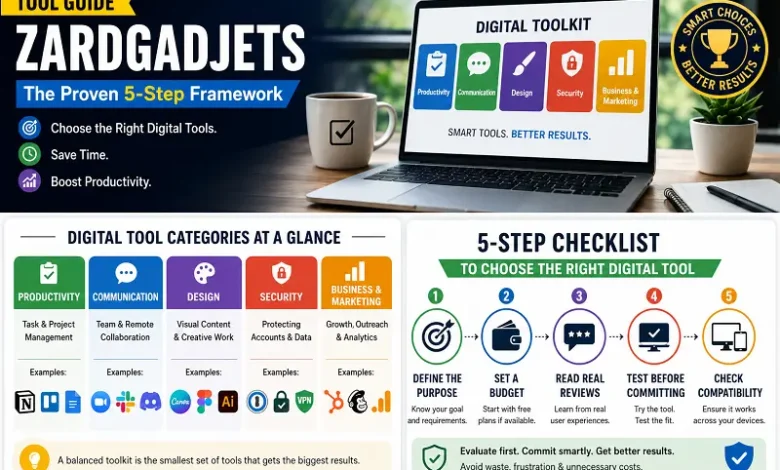
A useful digital-tool guide should cover more than one type of software. Existing Zardgadjets-related guides commonly discuss categories such as productivity, communication, creativity, education, marketing, and security.
Productivity and Organization
Productivity tools help users manage tasks, schedules, documents, notes, and projects. Their value is not simply having more features. The best option is usually the one that makes everyday organization feel less demanding.
For a small team, a visual project board may be enough. For a larger workflow, a more comprehensive project-management platform may make sense.
Design and Creative Work
Design applications range from simple browser-based editors to professional creative suites. Beginners often benefit from straightforward interfaces, while experienced designers may require advanced controls, collaboration features, and specialized formats.
The important consideration is capability versus complexity. Paying for professional features you never use does not necessarily improve your creative output.
Marketing and SEO
Digital marketing tools can help with keyword research, website analysis, content planning, email campaigns, and performance measurement. These platforms can be particularly valuable for website owners because they turn scattered information into measurable data.
Still, automated recommendations should be treated as guidance rather than absolute truth. Human judgment remains important when deciding what a particular audience actually needs.
Security and Privacy
Security deserves a place near the top of any modern tool-selection process. Antivirus software, password managers, authentication tools, and privacy-focused services can help reduce everyday digital risks.
Before trusting an unfamiliar service, users should examine its privacy policy, reputation, permissions, and data-handling practices. Convenience should never become an excuse to ignore security.
Comparing Tools Before You Commit
Instead of automatically choosing the most popular application, compare tools according to your actual requirements.
| Factor | Basic Tool | Advanced Tool | What to Consider |
|---|---|---|---|
| Ease of use | Usually simpler | May require training | How quickly can you become productive? |
| Features | Core functions | Broader capabilities | Which features do you genuinely need? |
| Cost | Often free or low-cost | Usually subscription-based | Does the extra functionality justify the price? |
| Collaboration | Limited | Often extensive | Will multiple people use it? |
| Customization | Minimal | Highly flexible | Do you need specialized workflows? |
| Security | Varies | Often more controls | What information will you store? |
This comparison highlights an important principle: the “best” tool is rarely universal. A sophisticated platform may be excellent for an agency but unnecessarily complicated for someone managing a personal project.
A Smarter Way to Evaluate a Digital Tool
Before signing up, installing software, or entering payment information, run through a short evaluation.
First, define the problem. “I need a productivity tool” is vague. “I need something to track five client projects” is much clearer.
Next, identify essential features. Separate must-have functions from attractive extras.
Then consider compatibility. A tool that works beautifully on its own may become inconvenient if it does not integrate with the applications you already use.
Finally, check ongoing costs. A low introductory price can become expensive when additional users, storage, exports, or premium features are added.
I have found that testing one tool against a specific task is far more useful than reading ten generic “best tools” lists.
A Real-World Example of Choosing the Right Tool
Imagine a freelance designer managing six clients. They need to track deadlines, communicate with customers, store project notes, and prepare visual content.
Instead of installing separate applications for every tiny task, the designer could first identify the central workflow. A project-management platform might handle deadlines and tasks, a communication service could manage conversations, and a design application could handle creative production.
The goal is not to collect the largest possible software library. It is to create a workflow where each application has a clear responsibility.
That is where a thoughtfully used online tool guide becomes valuable: it encourages users to build a purpose-driven digital toolkit rather than an overcrowded collection of subscriptions.
Common Mistakes to Avoid
One common mistake is selecting software because it is popular. Popularity can indicate usefulness, but it does not guarantee compatibility with your workflow.
Another mistake is choosing too many overlapping tools. If three applications perform almost the same job, switching between them may consume more time than they save.
Ignoring updates is another problem. Digital services change rapidly, and an old guide may contain instructions that no longer match the current interface. Recent discussions about Zardgadjets specifically highlight the importance of checking current guides when older instructions no longer correspond with what users see.
Finally, do not overlook data protection. Before uploading sensitive files or connecting accounts, understand what information the service can access.
What Makes a Useful Zardgadjets-Style Guide Different?
The strongest value of this kind of resource is not simply listing hundreds of applications. It is helping readers make better decisions with less trial and error.
A genuinely useful guide should explain who a tool is for, what problem it solves, what limitations it has, and when an alternative might be more appropriate. That practical context is more valuable than exaggerated claims or endless feature lists.
Readers should also verify unfamiliar claims independently, particularly when different websites describe the Zardgadjets name in conflicting ways. Current search results show that the term is being used for substantially different types of content, so distinguishing verified information from promotional descriptions is essential.
FAQs
Is Zardgadjets a specific online tool?
The name is used inconsistently across current online sources. Some pages present it as a guide or digital-tool resource, while others associate it with different technology and gaming topics. It is therefore better to verify the specific website or service being referenced.
What can an online tool guide help me find?
It can help you discover productivity, design, marketing, educational, communication, security, and other digital solutions based on the task you want to accomplish.
Should I choose a free or paid tool?
Start with your requirements rather than the price. A free tool may be perfectly adequate for basic work, while a paid platform can be worthwhile when advanced features save significant time.
How can I avoid choosing the wrong software?
Define your goal first, identify essential features, check compatibility, review pricing, and test the tool before moving important work into it.
Why should I check whether a guide is current?
Online software changes frequently. Interfaces, pricing, features, and instructions can become outdated, so newer documentation is generally more useful than an old walkthrough.
Read More: Dowsstrike2045 Python: What It Is and How to Verify
Conclusion
The latest online tool guide zardgadjets search trend reflects a broader need: people want simpler ways to navigate an increasingly crowded digital landscape. Yet the name itself appears across different types of online content, so readers should avoid treating every claim as authoritative.
The better strategy is straightforward. Start with the problem, identify the features that genuinely matter, compare realistic alternatives, check security and pricing, and test before committing. Whether you are a student, freelancer, creator, business owner, or everyday internet user, a smaller collection of well-chosen tools can often outperform a huge library of applications.
The real advantage comes from making technology work for your workflow instead of forcing your workflow to adapt to technology. That mindset turns an ordinary tool search into a much smarter digital decision.