Danwarning70.com: Safety, Redirects & User Guide
Danwarning70.com: Safety, Redirects & User Guide

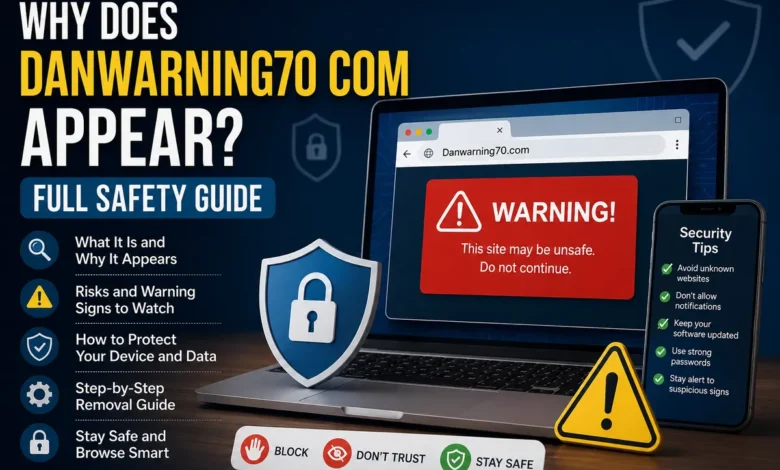
If you have recently encountered danwarning70.com, you may be wondering what it actually is, why it appeared in your browser, and whether you should trust it. The unusual domain name naturally raises questions, particularly when it appears unexpectedly through a redirect, advertisement, or browser notification.
The difficulty is that publicly available information about the domain is inconsistent. Some third-party articles describe it as an informational website covering technology, lifestyle, and general advice, while others associate the name with warning-style pop-ups and suspicious redirects.
That uncertainty is important. Rather than treating every online description as fact, it makes more sense to separate observable behavior from speculation. Here is what users should know before interacting with an unfamiliar domain like this.
What Is Danwarning70.com?
Danwarning70.com is a relatively obscure domain that has attracted online searches largely because people encounter it without necessarily knowing why. Several websites describe it as a general-purpose content platform, while others claim it can appear through redirects or browser notifications.
There is another particularly important piece of information: one recent review reports that the domain resolves through Cloudflare and redirects to an order page associated with Stansberry Research, including campaign-tracking information.
That behavior makes the domain difficult to classify as a conventional standalone website. A redirect domain may be used for advertising campaigns, marketing funnels, traffic routing, tracking, or other purposes. A redirect alone does not prove that a domain is malicious, but it does mean visitors should pay attention to where they are ultimately being sent.
Why Are People Searching for This Domain?
Search interest surrounding unfamiliar domains usually begins with an unexpected encounter.
Someone might see the address after clicking an advertisement, visiting a website with aggressive advertising, opening a questionable link, or receiving a browser notification. Naturally, the next step is to search the domain and ask whether it is legitimate.
This appears to be part of the reason danwarning70.com has generated discussion online. Multiple articles mention redirects, pop-ups, or warning-style pages as possible ways users encounter the domain.
However, there is an important distinction between a domain being associated with a browser redirect and the domain itself being proven malware. Those claims should not automatically be treated as interchangeable.
The Information Online Is Not Consistent
One of the biggest challenges when researching danwarning70.com is the lack of a consistent public description.
| Description found online | What it means for users | Confidence |
|---|---|---|
| General information website | Some articles describe broad technology, lifestyle, and productivity content | Limited |
| Redirect or campaign domain | One report documents redirection to a Stansberry Research order page | More concrete |
| Warning/pop-up domain | Several sites associate the name with alarming browser messages | Reported, but independently unverified |
| Confirmed malware | Some articles use strong security language | Not sufficiently established from the available evidence |
This comparison illustrates why simply reading one review can be misleading. Some published pages make definitive claims about malicious behavior, while others portray the domain as an ordinary content website.
For that reason, users should focus on what they actually encounter rather than assuming a dramatic description is automatically accurate.
Is Danwarning70.com Safe?
There is no responsible basis for saying that every visit to the domain will harm a device. At the same time, its unclear identity and reported redirect behavior justify caution.
A useful rule is simple: never trust a website merely because a browser page looks official.
If a page suddenly claims that your computer is infected, your account is compromised, or immediate action is required, stop before clicking anything. Browser pages can imitate security alerts surprisingly well. A website cannot be assumed to have performed a legitimate antivirus scan simply because it displays a convincing warning.
Several third-party reports specifically describe warning-style messages connected with the domain, although those reports do not provide enough independent evidence to establish every claim as fact.
What Should You Do If It Appears Unexpectedly?
Imagine you are reading an article online when a new tab suddenly opens. The page displays a frightening message saying your device is at risk and urges you to click a button immediately.
The safest response is not to panic.
Close the tab rather than following instructions on the unexpected page. Do not download software simply because the page tells you that your computer needs an urgent repair. Likewise, avoid entering passwords, credit-card details, phone numbers, or other sensitive information into an unfamiliar destination.
If you accidentally allowed browser notifications, review the notification permissions in your browser and remove permission for websites you do not recognize. You can also run a security scan using the trusted security software already installed on your device.
A Practical Way to Evaluate the Domain
When researching an unfamiliar website, consider five questions:
- Who operates it?
Look for identifiable ownership and contact information. - What is its actual purpose?
A legitimate website should make its purpose reasonably clear. - Where does the link take you?
Pay attention to redirects and changes in the domain. - What information does it request?
Be particularly cautious with payment details, passwords, and identity information. - Does the evidence agree?
If different sources make radically different claims, investigate further rather than accepting the most sensational explanation.
This approach is more useful than relying on a simple “safe” or “unsafe” label.
Danwarning70.com and Redirects: Why They Matter
Redirects are not inherently suspicious. Businesses commonly use redirects for campaigns, shortened links, advertising attribution, geographic routing, and tracking.
The concern arises when users are redirected without understanding why or when the destination attempts to pressure them into an immediate action.
The report connecting danwarning70.com with a Stansberry Research order page is therefore worth noting, but it should not automatically be interpreted as proof of wrongdoing.
The most valuable takeaway is to inspect the final destination, not just the original domain. If a page asks you to purchase something, subscribe, provide information, or install software, verify the organization independently before proceeding.
My Practical Take on Using Unfamiliar Domains
I have personally found that the safest response to an unexpected web warning is to close the page first and investigate afterward, rather than trying to solve the supposed problem from the warning itself.
That small change in behavior can prevent a moment of curiosity from becoming a security headache. It also removes the emotional pressure that suspicious pages sometimes create.
Danwarning70.com is a good example of why digital caution should be based on observable evidence. The domain has generated conflicting descriptions online, and that alone makes independent verification worthwhile.
What Makes This Domain Worth Investigating?
The unusual combination of a low-profile identity, conflicting third-party descriptions, and reported redirect behavior gives users a reason to investigate before interacting.
The key lesson extends beyond this particular address. A trustworthy online experience should not depend on fear, urgency, or confusion. If a website cannot clearly explain who operates it, what it does, and why it is asking you to take a particular action, there is little reason to rush.
That mindset is useful whether you encounter danwarning70.com, an unfamiliar advertisement, a suspicious notification, or any other unexpected web destination.
Read More: Falotani: Meaning, Origins, Uses & Key Insights
Conclusion
Danwarning70.com remains difficult to characterize with complete certainty because publicly available reports describe it in very different ways. Some sources portray it as an informational platform, while others connect the domain with redirects, warning messages, and browser notifications.
The clearest practical advice is therefore not to make an exaggerated judgment. Instead, treat unexpected encounters cautiously. Avoid clicking alarming messages, downloading unsolicited software, entering sensitive information, or assuming that a browser warning is a genuine security diagnosis.
If the domain redirects you somewhere, examine the final destination and verify the organization independently. In short, danwarning70.com is best approached with awareness rather than panic. Good browsing habits remain your strongest protection when a mysterious domain appears unexpectedly.
FAQs
What is danwarning70.com?
It is an obscure web domain that has generated online discussion because users may encounter it through links, redirects, advertisements, or browser notifications. Public descriptions of its purpose are inconsistent.
Is danwarning70.com a scam?
There is not enough reliable independent evidence to conclusively label the domain itself a scam. Some third-party websites make strong accusations, but those claims should be distinguished from independently verified observations.
Why does danwarning70.com appear in my browser?
Unexpected appearances can result from redirects, advertisements, links, or notification permissions. The exact reason depends on how the domain was encountered.
Should I download software recommended by the site?
No, not simply because an unfamiliar page recommends it. Verify the supposed security problem independently and obtain software from a trusted, official source.
What if I accidentally clicked it?
Do not panic. Close the page, avoid downloading anything, review browser notification permissions if necessary, and run a security scan with trusted security software if you believe something was downloaded or installed.
Can a browser warning prove that my device is infected?
No. A webpage can display a warning without actually scanning your device. Genuine security software should be used to determine whether a real infection exists.